


At first, it never occurred to me that I might be able to get back to driving after losing the use of my right arm and leg, but a few months after I came home from hospital my physiotherapist suggested that I should be able to drive a modified car. There are legal requirements for driving after a stroke, but here I want to write about the practical issues I encountered. It took me a long time to get a new driving licence, but that was partly because it was 2021 and Covid restrictions were in place. Nevertheless, I’m sure you will still need to be patient.
After the stroke, I notified the DVLA, as required by law, but despite accepting that I was in no condition to drive our existing car, I hung on to my driving licence as it still had several years to run. This was a good move since a new licence was a long time coming. If you do return your licence, keep copies of both sides. The DVLA Drivers Medical Group contacted my consultant to find out if I was medically fit to drive and in due course sent me a Special Controls form to complete once I knew whether I would need a modified car. To find out what was needed for me to control a car using only my left arm and leg, I applied to be assessed at our local Driving Mobility Centre, the William Merritt Centre in Leeds.
Few people can have a more dangerous job than the Occupational Therapist and Driving Assessor who were detailed to take me out on the road. We started in the car park, then on local side roads, as I got the hang of left-hand driving. I needed a secondary wireless steering device or “lollipop” to turn the wheel plus a left foot accelerator pedal, both shown in the pictures.
The lollipop made steering very straightforward and also had buttons for indicators and horn. Using brake and accelerator pedals with my left foot was fiendishly difficult at first. The problem is that when you first try driving with your left foot, it has none of the delicate fine control that you used to take for granted. Every time we approached a junction I would slow gently until it seemed like we were almost stopped, then inadvertently jab on the brake with such force that we finishd up with an emergency stop so vicious that whiplash seemed a real possibility, even though we were barely moving.
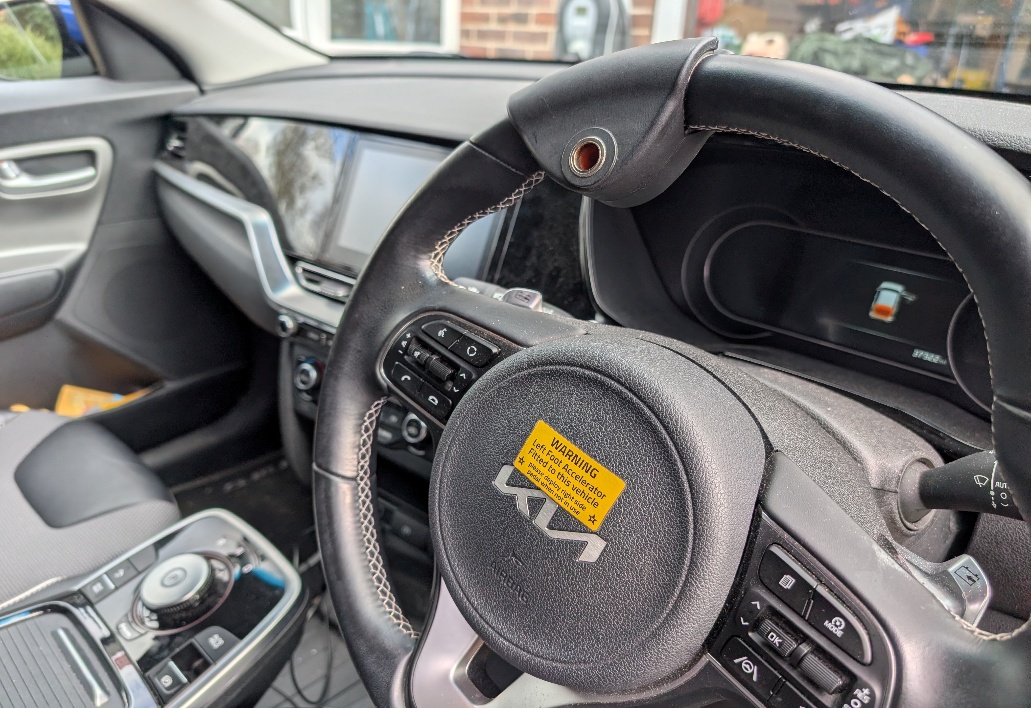
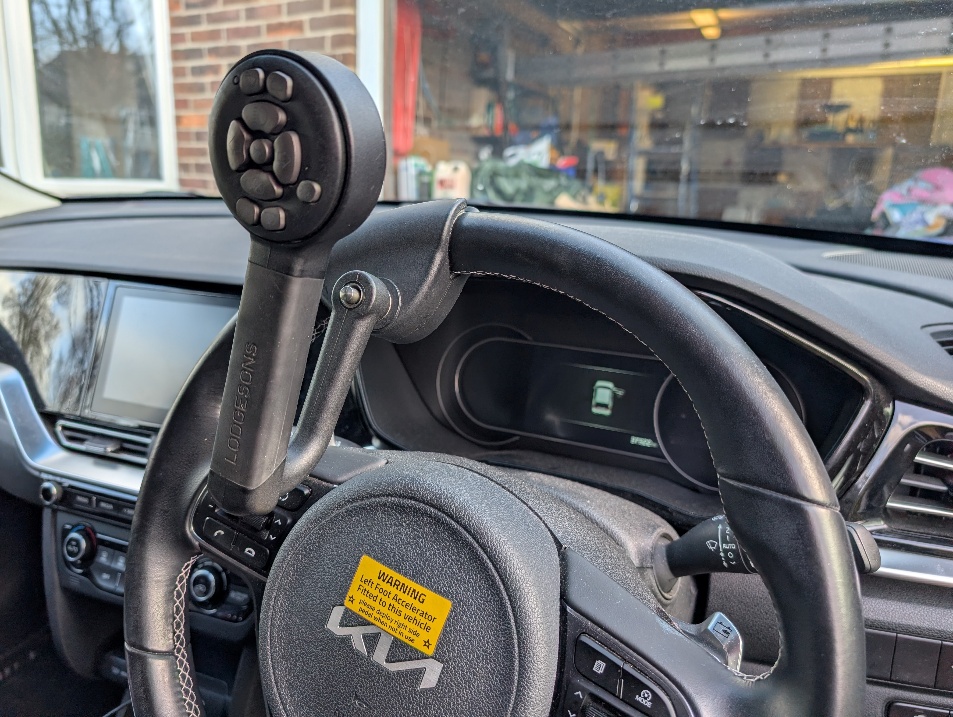
A 'lollipop' can be fitted (picture 2) or removed (picture 1) in seconds while the left foot accelerator pedal allows you to switch between left and right foot driving (pictures 3 and 4) just by pushing down whichever pedal the driver needs.
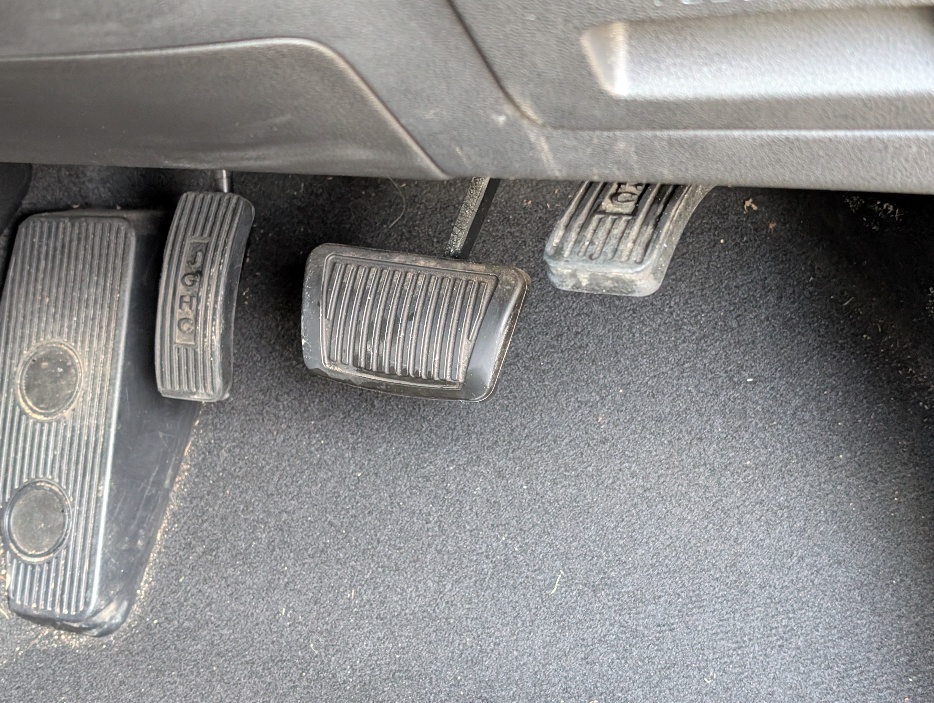
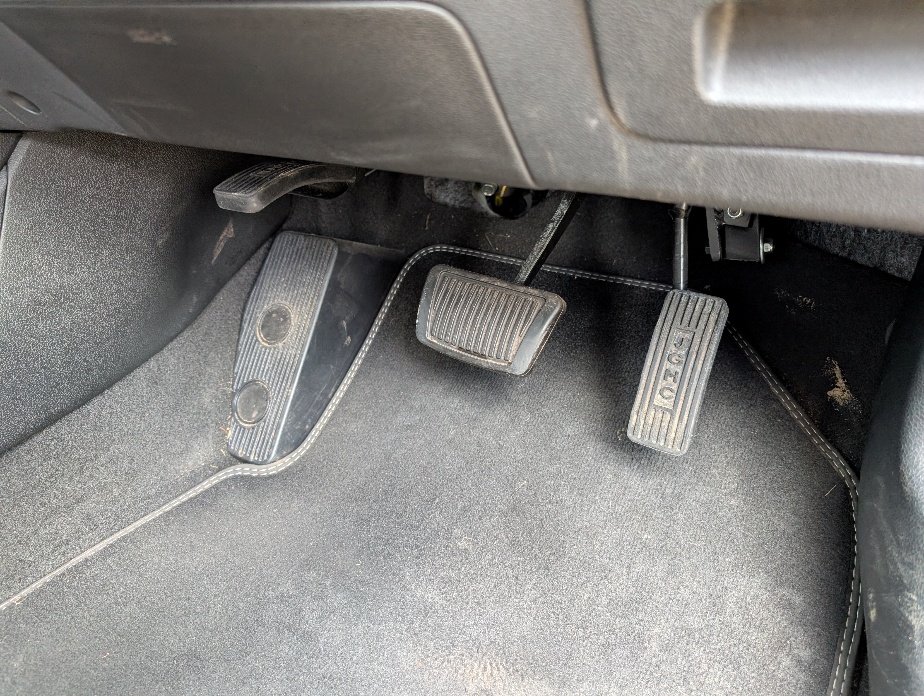
Despite the eccentric driving, we completed the assessment in one piece, and I was told which number codes I needed to fill in on the Special Controls form. I needed five codes to specify that I needed an automatic car with a lollipop to turn the wheel and operate key controls, as well as a left foot accelerator pedal. I received a Driving Assessment Report which summarised the assessment and said that if I took a series of lessons, I would be good to go. With the assessment complete, I could apply for a Medical Driving Licence.
Most people apply for a Driving Licence online, but now I’d lost my writing hand it turned out that I had to track down a post office that had the paper forms and fill one in by hand. Any fees have to be paid by cheque or postal order! I also had to submit a form about the medical condition and send in the Driving Assessment Report. Meanwhile, I took some lessons choosing from a list of instructors with modified cars that the Driving Mobility Centre had given me. The assessment had recommended a course of 10 lessons, but my instructor said that the full course would not be necessary, so we stopped early. It turned out that I should have taken the full number because the DVLA were not convinced that I was up to speed and, after several phone calls, wrote to me to say that they had decided that I would need to take an appraisal with a driving test examiner before they would issue me a new licence. Fortunately, they confirmed that I was able to drive with my old licence as by this point, I had bought my own modified car which was fitted with its special controls before we collected it from the dealer. I had retired before the stroke and was not eligible for the Motability scheme, but if you are eligible, you may get help. As with so much of stroke recovery, it helps if you have some money put by.
It took several more months before the appraisal could be organised and it proved to be a straightforward drive with the examiner. At the end she had duly ticked all the green boxes, and I thought that was finally the end of the saga. Not so, there was one last twist. My next letter from the DVLA had a new copy of the Special Controls form, instead of the licence I expected. The examiner had specified different codes to the ones I had been given when I originally completed the Special Controls Form, Fortunately, I had kept the phone number of the Drivers Medical Group and this was relatively straightforward to resolve. I finally got my licence a couple of weeks later.
The exact process is going to vary for different strokes and some may be easier to deal with, but do be aware that, because strokes are so individual, you are going to have to deal with people rather than computers.
At first, I found driving with the lollipop on the steering wheel quite tiring, but I have gradually got used to it and can manage for around two hours at a stretch – a very similar timescale to the one that my bladder operates on. This means that on long trips my wife and I can share the driving, with it taking just seconds to switch the car over between us. Nowadays I have much better use of my right hand, so I can rest it on the steering wheel to steady it without the fear that it might give an involuntary twitch. Being able to drive has made an enormous difference to life post-stroke. The process was long and sometimes complex but looking back it was all worth it. It hasn’t just given me back my independence, it has made me much less dependent on my wife and allowed her to lead a more independent life too.
Three Top Tips for getting back to driving:
- Start with your local Driving Mobility Centre and get some experience of driving with the modifications they recommend.
- Keep copies of everything you send to the DVLA and be prepared for things to go astray or be misinterpreted.
- There are many different strokes so this won’t always be an easy and straightforward process. Be patient but persistent because it’s definitely worth it!
Good Luck!


